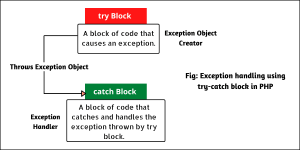
Exception handling in PHP is a powerful error-handling mechanism that allows us to handle runtime errors gracefully so that the normal flow of the program can be maintained.
When an unexpected situation occurs, such as dividing by zero, file not found, or database connection failure in a program, exception handling mechanism helps to manage these errors in a structured way instead of stopping script execution abruptly.
In modern PHP application development, exception handling is considered a best practice for writing robust, secure, and maintainable code.
In PHP, exceptions occur only at runtime, whereas syntax errors occur at parse time and you cannot handle it using the exception handling mechanism.
Let us first understand the concept of an exception in PHP with real-time examples.
What is Exception in PHP?
An exception in PHP is an object representing an error or an abnormal condition that occurs during the execution of program (runtime) and interrupts (disrupts) the normal execution flow of the program.
In other words, unwanted and unexpected behavior/event that interrupts the normal execution flow of the program is called exception in PHP. Let us take a real-time example of exception to understand this better.
Realtime Example of Exception and Exception Handling
Suppose a person is traveling by car from Dhanbad to Ranchi. After traveling some distance, the tire of his car gets punctured. This unexpected and unwanted situation represents an exception.
The car owner always keeps an extra tire as an alternative on a long-distance journey. He changes the punctured tire with a new tire. After changing the tire, he continues the rest of the journey. This alternative solution represents exception handling, which allows the journey to continue without interruption.

Similarly, when we write a PHP program and it is parsed successfully, unexpected problems may still occur at runtime due to logical errors, invalid input, or external factors such as file or database issues. These problems are treated as exceptions. These exceptions must be handled to maintain the normal execution flow of the program.
[blocksy-content-block id=”12371″]
If an exception is not handled properly, the rest of the code in the program will not execute. To avoid this, PHP provides an exception handling mechanism using try, catch, and finally blocks.
By handling exceptions, we can display meaningful and user-friendly error messages rather than system-generated error messages, which are difficult to understand. This improves application reliability and user experience.
Simple Example of Exception in PHP (Division by Zero)
Let us take a simple example to understand how an exception is created and thrown in PHP. In this example, we manually throw an exception when a division by zero condition occurs.
<?php
try {
   $a = 20;
   $b = 0;

// Check for division by zero.
   if ($b == 0) {
    // Creating and throwing an exception.
       throw new Exception("Division by zero is not allowed.");
   }
// This line will execute only if no exception is thrown from try block.
   $result = $a / $b;
   echo "Result: " . $result;

} catch (Exception $e) {
   // Catching and handling the exception inside the catch block.
      echo "Error Message: " . $e->getMessage();
}
?>
Output:
Error Message: Division by zero is not allowed.
In this example:
- We have declared a try block, which contains code that may cause an exception.
- Inside the try block, we have defined two variables $a and $b, which store two numbers for division.
- Before performing the division operation, we have used an if statement to check whether the divisor is zero or not.
- If $b is equal to 0, an exception is created and thrown using the throw keyword.
- When an exception is thrown, the normal execution flow of the try block stops immediately, and the remaining code inside the block is not executed.
- The control is then transferred to the catch block, which catches the thrown exception and handles it appropriately.
- The getMessage() method is used to display a user-friendly error message on the output screen, which prevents the PHP script from terminating abruptly.
[blocksy-content-block id=”12121″]
If the exception is not handled by the catch block, PHP stops script execution immediately and the remaining code after throw is never executed. In this situation, PHP displays a system-generated error message like this:
Fatal error: Uncaught Exception: Division by zero is not allowed.
Why Does an Exception Occur in a PHP Program?
An exception in a PHP program occurs when an unexpected or abnormal situation arises during the execution of program that prevents the execution of code normally. Some common reasons why exceptions may occur in a PHP program include:
- Attempting to open or read a file that does not exist there.
- Writing data to a disk that is full, read-only, or improperly formatted.
- When the program asks for user input and the user enters invalid data.
- When the user attempts a division operation where the divisor is zero and the condition is manually checked and thrown as an exception.
- Processing invalid or corrupted data streams, such as improperly formatted JSON, XML, or API responses.
- Encountering type mismatches or invalid arguments, which may be thrown automatically by PHP as Error objects in modern PHP versions.
Keywords Used for Exception Handling in PHP
PHP provides the following specialized keywords for exception handling:
- try: This represents a block of code in which an exception may occur. The code that is likely to generate an exception is placed inside the try block.
- catch: This represents a block of code that is executed when an exception is thrown inside the corresponding try block. It catches and handles the exception.
- throw: The throw keyword is used to explicitly create and throw an exception. When an exception is thrown, the normal execution flow of the program is interrupted, and control is transferred to the nearest matching catch block.
- finally: The keyword finally represents a block of code that is always executed, whether an exception is thrown or not. It is mainly used for cleanup activities such as closing files, releasing resources, or cleaning up memory. The finally block can be used after a catch block or even without a catch block.
We will understand these exception-handling keywords in more detail in the upcoming tutorials, one by one, with the help of practical examples.
Advantages of Exception Handling in PHP
Exception handling offers several benefits that help to develop robust, secure, and maintainable PHP applications.
- The main advantage of using exception handling mechanism is to maintain normal flow of the program without abrupt interruption.
- You can handle fatal errors gracefully without stopping the entire application unexpectedly.
- The rest of the code continues to execute normally after handling the exception.
- Exception handling improves code readability by separating error-handling logic from normal program logic.
- The code remains clean and easy to understand because it becomes more structured and organized.
- With exception handling, you can generate meaningful and user-friendly error messages.
- You can log detailed technical errors while showing simple messages to users.
- Using exception handling, you can make debugging and maintenance easier when changes are required.
Conclusion
Exception handling in PHP is a powerful mechanism that allows you to handle runtime errors gracefully without unexpected interruptions. It helps to maintain the normal execution flow of the program. It improves the code readability, maintainability, and security. When used properly, exception handling helps manage runtime errors efficiently and makes applications more robust.
We hope you have understood the basic concepts of exception handling in PHP. Stay tuned for the next tutorial, where we will learn how to handle exceptions using the try…catch block in PHP.