
MySQL is one of the world’s most popular open-source relational database management systems (RDBMS). It uses Structured Query Language (SQL) to store, manage, and manipulate data. In MySQL,
- “My” refers to My Widenius, the daughter of co-founder Michael Widenius. He is known for naming database projects after his children.
- “SQL” stands for Structured Query Language, which is the standardized programming language used to manage and manipulate relational databases.
MySQL is one of the most widely used databases in web applications because of its speed, reliability, scalability, and ease of use. As MySQL is an open-source product, it is free, and you don’t need to purchase it in order to use it.
MySQL is cross-platform and supports operating systems such as Windows, Linux, and macOS. It can be used with programming languages like PHP, Java, and Python to build dynamic applications. Because of its flexibility and performance, MySQL is suitable for both small projects and enterprise-scale applications.
History of MySQL
MySQL was created in 1995 by Michael Widenius, David Axmark, and Allan Larsson. It was officially released in May 1995. It was developed as an open-source relational database management system (RDBMS) to provide high speed, simplicity, and reliability for storing and managing data.
In the late 1990s, MySQL became popular with web developers. It became widely used for dynamic websites built using the LAMP stack:
- Linux
- Apache
- MySQL
- PHP/Perl/Python
Many developers chose MySQL because it was open-source, fast, and easy to use. MySQL is often used with:
- PHP
- Java
- Python
- Node.js
- WordPress
- Apache
Sun Microsystems Acquires MySQL (2008)
In 2008, Sun Microsystems acquired MySQL for approximately $1 billion. Sun invested in development, enterprise support, scalability, and community growth.
Oracle Acquisition (2010)
In 2010, Oracle Corporation acquired Sun Microsystems, and through this acquisition, MySQL became part of Oracle. Over the years, MySQL introduced major improvements such as:
- Transactions with InnoDB
- Stored procedures
- Triggers
- JSON support
- Advanced features in MySQL 8.0
MySQL 8.4 LTS (2024–Present)
Today, the latest major long-term support version is MySQL 8.4 LTS, which offers better performance, security, and reliability.
MySQL Today
Today MySQL is used in:
- Web applications
- Enterprise systems
- E-commerce
- Cloud platforms
- Educational systems
- Banking applications
- Content management systems
It remains one of the most widely used open-source databases in the world.
How MySQL Works (Step by Step)
MySQL follows a client-server architecture. It is a client/server system. There is a database server (MySQL) and multiple clients (application programs) that communicate with this server. When a user or application sends an SQL query, MySQL processes it through several internal components before returning the result.
MySQL Working Architecture
We can understand the working flow in the following steps:
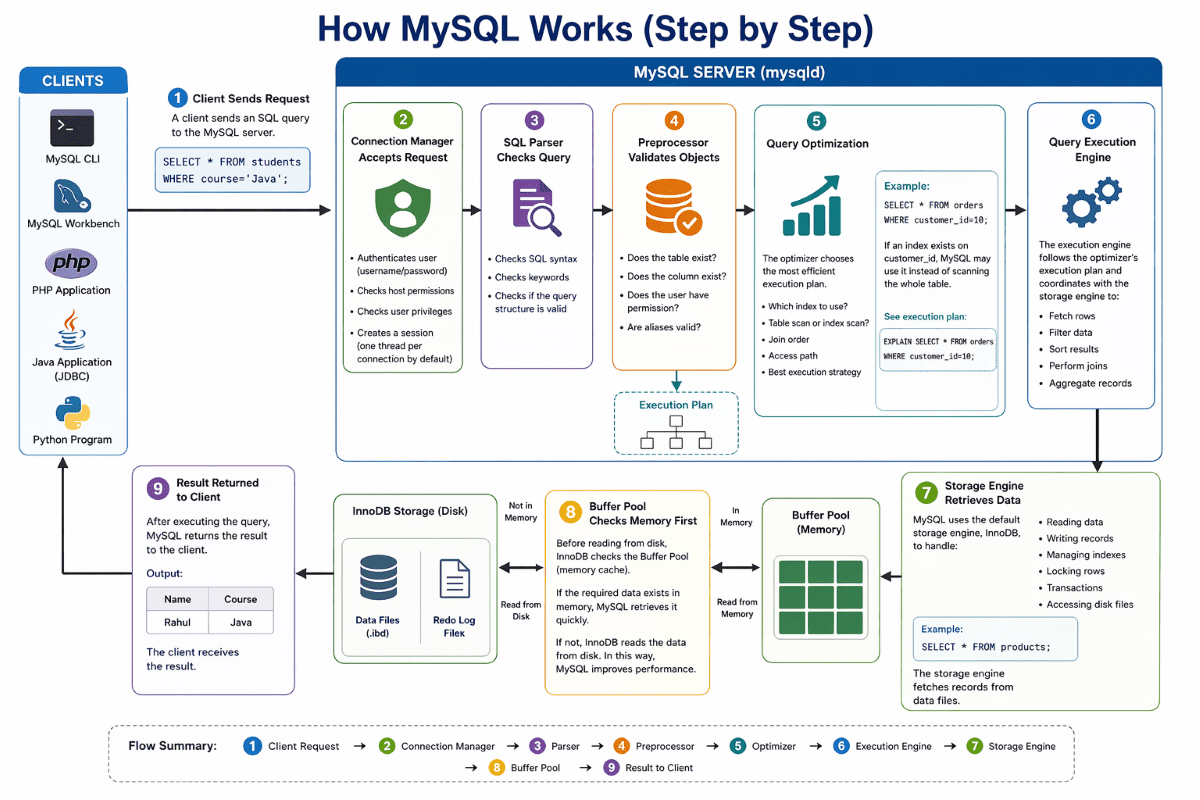
Step 1: Client Sends Request
A user or application sends an SQL query to the MySQL server. Examples of clients may be:
- MySQL Command Line Client
- MySQL Workbench
- PHP application
- Java application using JDBC
- Python programs
Example query:
SELECT * FROM students WHERE course='Java';
This query is sent to the MySQL server (mysqld).
Step 2: Connection Manager Accepts Request
The Connection Manager handles the incoming client connections and authenticates users. It checks the following things:
- Username
- Password
- Host permissions
- User privileges
If authentication fails, the MySQL server rejects the connection. By default, MySQL uses a one-thread-per-connection model to handle client sessions. Under this architecture, the MySQL server assigns a dedicated operating system thread to each client connection for the entire duration of the session.
Step 3: SQL Parser Checks Query
The Parser analyzes the SQL query to check the following:
- SQL syntax
- Keywords
- Whether the query structure valid
Example:
SELECT name FROM students;
This is a valid SQL query, so MySQL moves to the next step.
Step 4: Preprocessor Validates Objects
The preprocessor validates database objects and checks the following:
- Does the table exist?
- Does the column exist?
- Does the user have permission?
- Are aliases valid?
Example:
SELECT salary FROM employees;
If the salary column does not exist, MySQL stops here.
Step 5: Query Optimization
This is one of the most important stages. The optimizer chooses the most efficient execution plan for the query. It decides:
- Which index to use?
- Table scan or index scan
- Join order
- Access path
- Best execution strategy
Example:
SELECT * FROM orders

WHERE customer_id=10;
If an index exists on customer_id, MySQL may use it instead of scanning the whole table. The optimizer creates an execution plan, which you can see using the following code:
EXPLAIN SELECT * FROM orders

WHERE customer_id=10;
Step 6: Query Execution Engine
The Execution Engine follows the optimizer’s execution plan and coordinates with the storage engine to perform operations such as:
- Fetch rows
- Filter data
- Sort results
- Perform joins
- Aggregate records
Step 7: Storage Engine Retrieves Data
MySQL uses the default storage engine, InnoDB, to handle the following:
- Reading data
- Writing records
- Managing indexes
- Locking rows
- Transactions
- Accessing disk files
Example:
SELECT * FROM products;
The storage engine fetches records from data files.
Step 8: Buffer Pool Checks Memory First
Before reading from disk, the default storage engine InnoDB checks the Buffer Pool (memory cache). If the required data exists in memory, MySQL retrieves it quickly. If not, InnoDB reads the data from disk. In this way, MySQL improves performance.
Step 9: Result Returned to Client
After executing the query, MySQL returns the result to the client.
Output:
Name Course
Rahul Java
The client receives the result.
Key Features in MySQL
MySQL offers several unique and powerful features:
- Open-Source: MySQL Community Edition is free and open source under the GNU General Public License (GPL), while commercial editions are also available from Oracle Corporation.
- Relational Database System: MySQL is a relational database system like almost all other database systems in the market.
- SQL Support: MySQL supports SQL (Structured Query Language), which is a standardized language for querying and updating data and for the administration of a database.
- High Performance: MySQL is known for its high speed performance. It provides fast indexing, query optimization, memory caching, partitioning, retrieval, and processing for large datasets.
- Scalability: MySQL can handle large and complex databases without any performance drop. It can handle high-traffic workloads with features like partitioning, clustering, replication, and optimization tools.
- Security: MySQL includes a powerful system to control access to data. It uses a host- and user-based privilege system to control who can access specific information. MySQL also supports TLS/SSL encrypted connections to allow secure communication between clients and the server.
- Portability: MySQL can run on different operating systems like Unix, Linux, Windows, and MacOS.
- Connectivity: MySQL supports TCP/IP sockets, Unix sockets, and named pipes. In addition, MySQL supports remote access over networks when configured securely. Multiple users can access MySQL database simultaneously. MySQL also provides APIs to support connectivity from applications written in languages such as C, C++, Perl, Java, Python, and PHP.
- Ease of Use: MySQL is simple to use and implement. A user can easily install MySQL on the system and run it within minutes after downloading files. MySQL also has a detailed manual, a large number of free online tutorials, and a developer community available for MySQL.
- Transactions: MySQL supports transactions through the default storage engine, InnoDB.
- Replication: MySQL supports replication, which allows the content of a database to be copied onto a number of computers. It is done to increase protection against system failure and to improve the speed of database queries.
- Stored Procedures: MySQL has supported the stored procedures (SPs) feature since version 5.0. Stored procedures allow reusable database logic and can automate operations such as inserts, updates, deletes, validation, and business rules.
- JSON Support: MySQL 5.7 and later support a native JSON data type for storing, validating, and querying JSON documents.
Why Use MySQL?
There are several reasons why many developers choose MySQL.
- MySQL is easy to learn for beginners because its SQL syntax is beginner-friendly.
- MySQL Community Edition is free, making it a good choice for startups and students.
- MySQL is suitable for small businesses, medium-sized organizations, and large enterprise applications.
- It is useful in schools and universities for teaching database management and SQL concepts.
- It offers high performance for many workloads.
- It has wide community support, with thousands of tutorials, forums, and documentation available.
- MySQL is cross-platform, meaning it can run on operating systems such as Windows, Linux, and macOS.
- It can be integrated with programming languages such as Java (JDBC), PHP, Python, C++, and Node.js.
Applications of MySQL
MySQL is used in many industries for storing, managing, and retrieving data. Some major applications of MySQL are as follows:
- MySQL powers many web applications by storing and managing user accounts, blog posts, comments, and product catalogs.
- It supports e-commerce applications by managing products, customer records, orders, and payment data.
- MySQL stores and manages account records, financial transactions, and customer information in the banking applications.
- Schools and colleges use MySQL in student management systems to manage student records, exam data, and attendance systems.
- MySQL supports content management systems by managing blogs, news portals, and discussion forums.
- It supports mobile applications by managing backend data such as user profiles, app content, and transactions.
- MySQL stores and manages sensor-generated data, device information, and real-time monitoring records. IoT systems use MySQL for data storage and analysis.
Advantages of MySQL
There are the following advantages of using MySQL. They are:
- Free and open source
- Easy installation
- High speed
- Strong security
- Scalable
- Large community
- Multiple storage engines
- Backup and recovery support
- Cross-platform support
Difference Between MySQL and SQL
| Basis | MySQL | SQL |
|---|---|---|
| Type | Database software | Query language |
| Full Form | My Structured Query Language | Structured Query Language |
| Purpose | Stores and manages data | Communicates with databases |
| Nature | Software | Language |
| Developed By | Oracle | ANSI Standard |
| Use | Database management | Writing queries |
| Example | MySQL Server | SELECT statement |
