Laravel’s mail system runs on Symfony Mailer, which means most transactional email providers plug in through a driver, a native transport, or an SDK bridge with just a few lines of config. The hard part is picking a provider that keeps password resets and order confirmations out of the spam folder once the app is sending production volume.
The best transactional email APIs for Laravel developers in 2026 are Mailtrap, Twilio SendGrid, Mailgun, and Amazon SES. Each takes a different approach to integration, pricing, and infrastructure, and the right pick depends on what the rest of the stack looks like.
Laravel Email API Comparison
| Provider | Best for | Laravel integration | Free tier | Starting price |
|---|---|---|---|---|
| Mailtrap | High deliverability and stream separation | Official Laravel bridge (own PHP SDK) | Up to 4,000 emails/month | $15/month (10,000 emails) |
| Twilio SendGrid | Enterprise ecosystem | Community Laravel driver | 100 emails/day (60-day trial) | $19.95/month (50,000 emails) |
| Mailgun | Validation and routing | Native Symfony transport | 100 emails/day | $15/month (10,000 emails) |
| Amazon SES | AWS-native cost | Native Laravel driver via AWS SDK | 3,000 emails/month (first 12 months, EC2) | $0.10 per 1,000 emails |
Mailtrap fits best when a team wants transactional and bulk email running on separate infrastructure without assembling it themselves.
Twilio SendGrid earns its place when the team already runs SMS or voice through Twilio and wants billing and tooling under one account.
For teams that treat pre-send address validation and custom inbound routing as requirements rather than nice-to-haves, Mailgun is worth the extra setup time. And when the application already lives on AWS, Amazon SES usually wins on cost alone.
Mailtrap: Best for High Deliverability
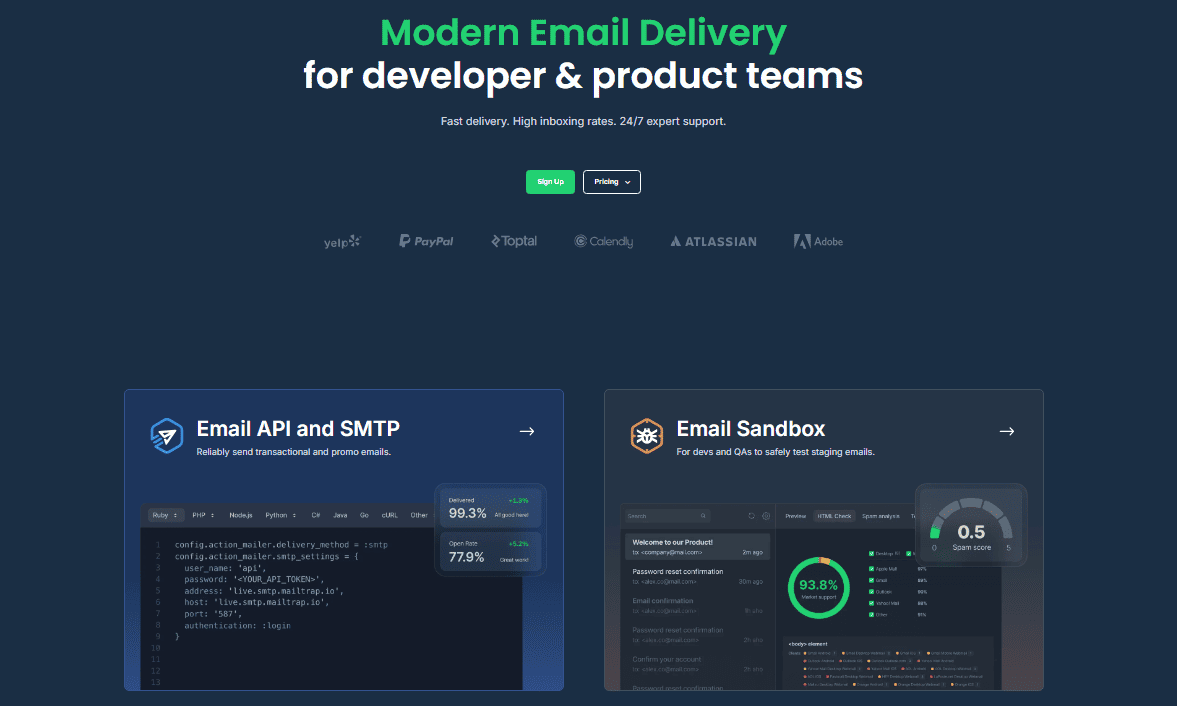
Mailtrap is an email delivery platform for developer and product teams that need transactional and bulk email to stay architecturally separate. It runs isolated sending streams with independent IP pools, so a spike in marketing complaints doesn’t drag down the sender reputation of a password reset or an order confirmation.
Laravel Integration
Mailtrap ships an official Laravel bridge as part of its PHP SDK, and Laravel 9 and up are supported out of the box. The bridge registers a custom transport that plugs directly into Symfony Mailer, so there’s no manual client instantiation.
Install the package, add the mailer entry to config/mail.php, drop the API key into .env, and send through Laravel’s normal Mail facade or Mailable classes.
DKIM keys rotate automatically every month, which takes one more thing off a team’s plate. Webhooks cover opens, clicks, bounces, and spam complaints with 40 retries every five minutes, and analytics are included on every paid plan rather than gated behind a higher tier. The
API supports customizable throttling, batches of up to 500 messages, and payloads up to 10 MB, so it holds up under queued jobs and notification-heavy Laravel apps without extra configuration. On the compliance side, Mailtrap is ISO 27001 and SOC 2 certified and GDPR compliant, which tends to matter once a security review shows up in the sales process.
# Install
composer require railsware/mailtrap-php symfony/http-client nyholm/psr7

# config/mail.php
'mailers' => [
    'mailtrap' => [
        'transport' => 'mailtrap',
    ],
],

# .env
MAIL_MAILER=mailtrap
MAILTRAP_HOST=send.api.mailtrap.io
MAILTRAP_API_KEY=your_api_key

# Send
use App\Mail\WelcomeMail;
use Illuminate\Support\Facades\Mail;

Mail::to('recipient@example.com')->send(new WelcomeMail($data));
That’s the whole setup. No separate client to instantiate, no new mental model for how Mailables work.
Pricing starts free for up to 4,000 emails a month, with paid plans from $15/month for 10,000 emails. The business plan ($85/month) covers 100,000 emails and adds a dedicated IP with automatic warmup; enterprise starts at $750/month for 1.5 million emails.
Best for: Laravel teams that want stream separation, complete analytics, and a five-minute setup without stitching together separate infrastructure.
Twilio SendGrid: Best for Enterprise Ecosystem
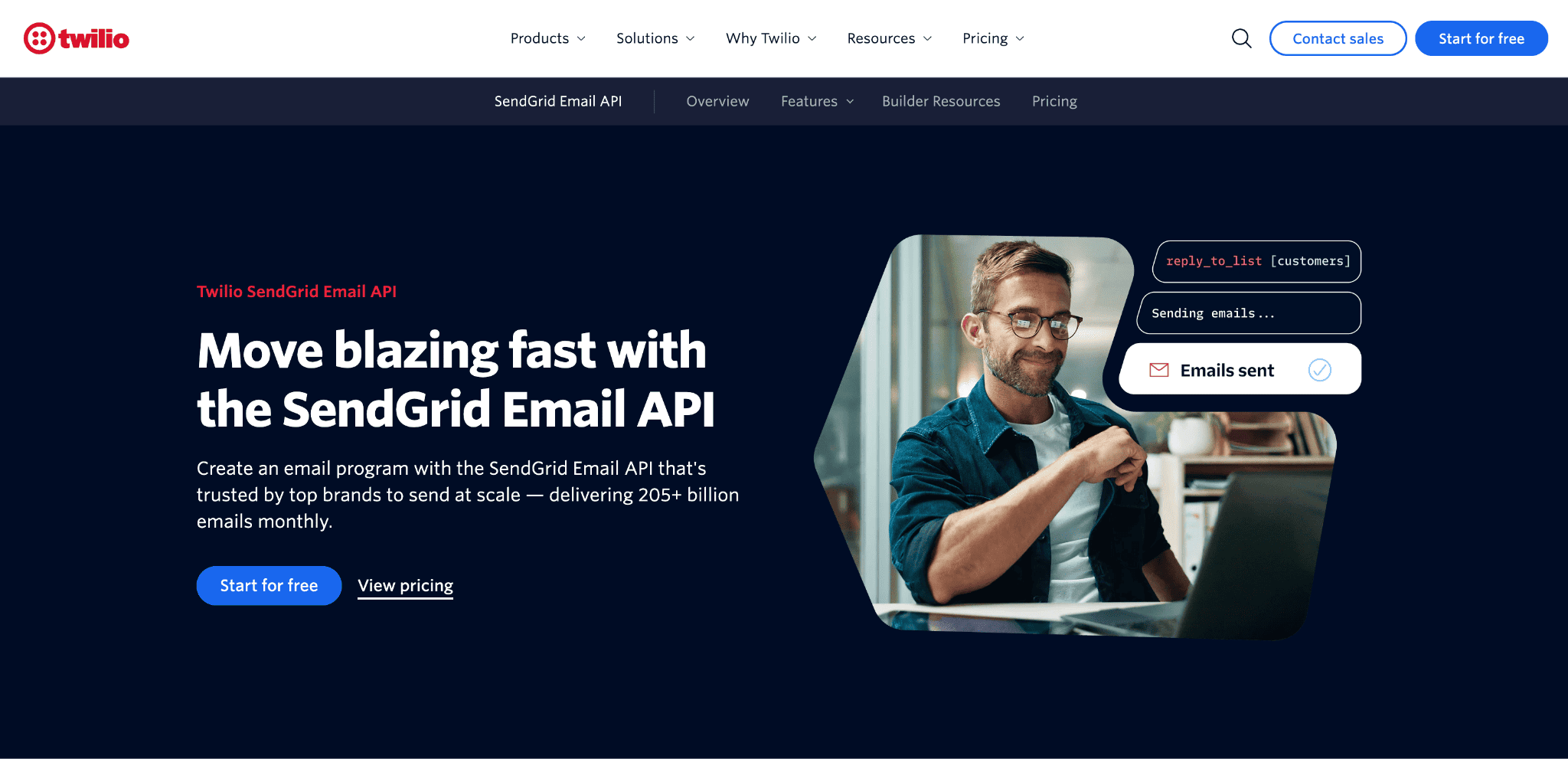
Twilio SendGrid has been around the longest of the four. Launched in 2009, folded into Twilio in 2019, and still carrying more third-party footprint than anyone else here: the PHP SDK alone has over 44 million installs on Packagist.
Laravel Integration
Where Mailtrap ships its own bridge, SendGrid leans on a community package. There’s no official Symfony transport, so Laravel developers typically reach for s-ichikawa/laravel-sendgrid-driver, which registers a native mail driver. It isn’t first-party, but it’s well established, with over 8 million downloads on Packagist and a mention on the Laravel news portal.
Setup takes about five minutes: install the package, add the API key to config/services.php, point MAIL_MAILER at sendgrid, and send through the standard Mail facade.
SendGrid isolates sending environments, tracks metrics separately, and manages permissions across projects. Dynamic templates use Handlebars syntax with versioning and A/B testing built in, so marketing and product teams can iterate on transactional email copy without a developer opening a pull request every time.
And because SendGrid sits inside Twilio’s broader platform, email and SMS notifications can fire from the same account and land on the same invoice.
# Install
composer require s-ichikawa/laravel-sendgrid-driver

# config/services.php
'sendgrid' => [
    'api_key' => env('SENDGRID_API_KEY'),
],

# .env
MAIL_MAILER=sendgrid
SENDGRID_API_KEY=your_api_key

# Send
use App\Mail\WelcomeMail;
use Illuminate\Support\Facades\Mail;

Mail::to('recipient@example.com')->send(new WelcomeMail($data));
Pricing starts with a 60-day trial covering 100 emails a day, then paid plans from $19.95/month for 50,000 emails, up to $89.95/month for 100,000.
Best for: Enterprise teams already inside the Twilio ecosystem, or teams that need subuser-level isolation across multiple products.
Mailgun: Best for Validation and Routing
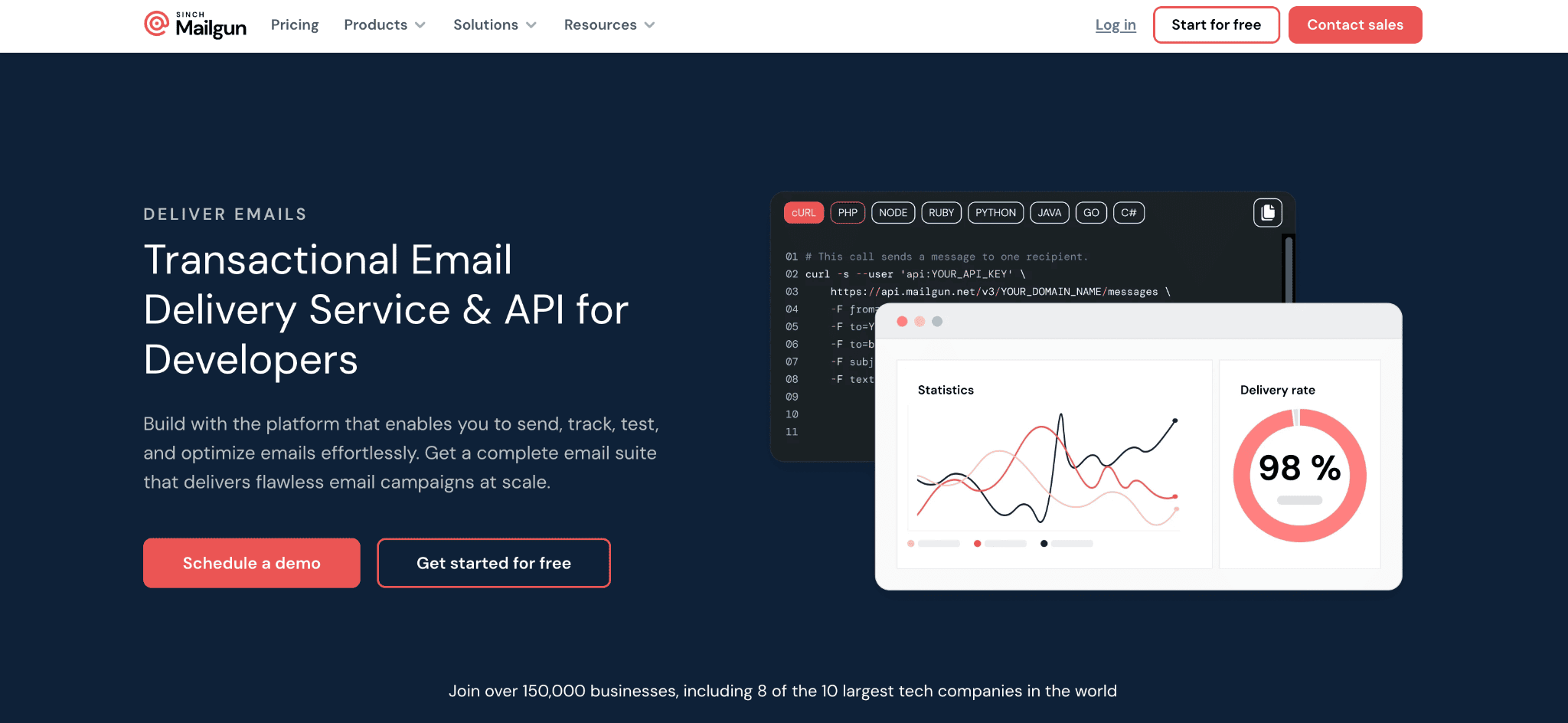
Mailgun cares less about templates than about what happens to a message before and after it goes out. Its standout feature is a built-in email validation API that checks addresses against DNS and MX records and disposable-domain lists before sending. That catches the bounce spikes that quietly wreck sender reputation before they happen, not after.
Laravel Integration
Every version of Laravel past 9 has Mailgun pre-configured as a native mail driver, built on the same official Symfony transport package. Install it, drop the domain and secret into config/services.php, and set the endpoint in .env.
Watch for one thing: Mailgun runs separate infrastructure for the US and EU regions. Accounts created in the EU need the endpoint set accordingly, or API calls fail with an authentication error. It’s the kind of thing that only shows up after a deploy, not during setup.
Inbound routing is what else sets it apart. Rules can forward, filter, or route incoming email to different webhooks based on regex patterns, covering reply-by-email workflows and email-based support ticketing in a way most competitors don’t handle natively.
Batch sends accept up to 1,000 recipients per API call with per-address recipient variables, so a queued newsletter job doesn’t need a loop calling the API once per subscriber. Mailgun is SOC 2 and GDPR compliant, with HIPAA coverage available through a signed BAA for teams that need it.
# Install
composer require symfony/mailgun-mailer symfony/http-client

# config/services.php
'mailgun' => [
    'domain' => env('MAILGUN_DOMAIN'),
    'secret' => env('MAILGUN_SECRET'),
    'endpoint' => env('MAILGUN_ENDPOINT', 'api.mailgun.net'),
],

# .env
MAIL_MAILER=mailgun
MAILGUN_DOMAIN=mg.yourdomain.com
MAILGUN_SECRET=your_api_key

# Send
use App\Mail\WelcomeMail;
use Illuminate\Support\Facades\Mail;

Mail::to('recipient@example.com')->send(new WelcomeMail($data));
Pricing starts free for 100 emails a day, then $15/month for 10,000 emails, $35/month for 50,000 (Foundation), and $90/month for 100,000 (Scale). The validation API itself requires a separate Mailgun Optimize subscription.
Best for: Teams that treat pre-send validation and custom inbound routing as requirements, not extras.
Amazon SES: Best for AWS-Native Cost
Nothing here touches Amazon SES on price. However, where the other three sell deliverability tooling and templates, SES sells raw infrastructure at $0.10 per 1,000 emails, and it’s the best pick for teams whose stack already lives on AWS.
Laravel Integration
Laravel 9 and up have SES pre-configured as a native mail driver, using the official Symfony transport package under the hood. Install the AWS SDK, add the access key, secret, and region to config/services.php, and set the same values in .env.
But here’s the catch: SES also requires IAM permissions configured in the AWS console before it will send anything, and new accounts start in sandbox mode until AWS approves a request to send to unverified addresses. Budget more setup time here than with the other three providers.
Once that’s done, SES integrates cleanly with the rest of AWS: Lambda for processing bounce notifications through SNS, S3 for storing message content, and CloudWatch for monitoring send volume. It also supports data residency across EU, US, and Asian regions.
The tradeoff is that analytics stay basic out of the box. There’s no built-in open or click dashboard, so teams that want that level of detail end up wiring up CloudWatch or SNS themselves.
# Install
composer require aws/aws-sdk-php

# config/services.php
'ses' => [
    'key' => env('AWS_ACCESS_KEY_ID'),
    'secret' => env('AWS_SECRET_ACCESS_KEY'),
    'region' => env('AWS_DEFAULT_REGION', 'us-east-1'),
],

# .env
MAIL_MAILER=ses
AWS_ACCESS_KEY_ID=your_key
AWS_SECRET_ACCESS_KEY=your_secret
AWS_DEFAULT_REGION=us-east-1

# Send
use App\Mail\WelcomeMail;
use Illuminate\Support\Facades\Mail;

Mail::to('recipient@example.com')->send(new WelcomeMail($data));
Pricing runs $0.10 per 1,000 emails, with the first 3,000 emails a month free for 12 months when sending from EC2.
Best for: AWS-native teams with the DevOps capacity to handle IAM and sandbox setup themselves, where cost per email is the deciding factor.
Wrap-up
Mailtrap, Twilio SendGrid, Mailgun, and Amazon SES all plug into Laravel’s Symfony Mailer-based system without much friction. The true decision comes down to what the rest of the stack looks like, not which provider has the longest feature list.
Mailtrap covers the most ground for teams that want stream separation and full analytics without assembling it themselves. Twilio SendGrid makes sense inside an existing Twilio account, especially once subuser management enters the picture.
Mailgun earns its setup time when validation and inbound routing are requirements rather than someday-features. Amazon SES is hard to beat on cost if the infrastructure is already on AWS and the team has the IAM experience to match.
None of these four will give you trouble wiring into Laravel. What separates them is what happens after launch, when real volume shows up and deliverability either holds or it doesn’t.