Top 50 Computer Architecture MCQ Questions
Here, we have listed the most important computer organization and architecture MCQ questions with answers and explanations.
This computer architecture MCQ questions can be asked in various competitive examinations such as RRB, SSC CGL, IBPS (Clerk & PO), Group-D, etc.
We have also covered those questions based on computer organization and architecture that have been asked in different competitive exams and can be chanced to ask again in the various exams.
You will get multiple-choice questions based on computer architecture from basic to advanced that will enhance your knowledge to crack any competitive exams. So, let’s start practice.
Computer Organization and Architecture MCQs
1. The first computer architecture was designed (or developed) in
a) 1970
b) 1971
c) 1968
d) 1972
Answer: (a), The first computer architecture was designed in 1970. Computer architecture is the organization and interconnection of various components of the computer system.
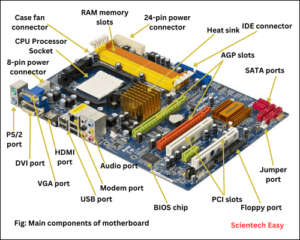
2. The main components (or basic units) of a computer system are
a) Input/Output unit
b) Central Process Unit (CPU)
c) Memory unit (Storage unit)
d) All of the above
Answer: (d)
3. The major basic functions performed by a computer are
a) Data and Instructions are accepted as input.
b) Data and Instructions are stored (called data storage).
c) Processing of data as per the instructions (called data processing)
d) Control of all operations inside the computer and produced the result in the form of output.
e) All of the above
Answer: (e)
4. The main functions of the input unit of a computer are
a) It reads (or accepts) the list of instructions and data from the outside.
b) It converts these instructions and data in computer acceptable format.
c) It supplies (or feeds) the converted instructions and data to CPU or memory (i.e. computer system) for further processing.
d) All of the above
Answer: (d)
5. The device used to fetch (or bring) instructions and data into a computer system is called
a) ALU
b) Control unit
c) Input device
d) Output device
Answer: (c), Input devices are those devices with the help of which we enter data into the computer. They make a connection between user and computer. Input devices translate (or change) human-readable information into a form understandable by the computer.
6. Processing involves
a) inputting data into a computer system
b) transforming input into output
c) displaying output in a useful manner
d) providing a relevant answer
Answer: (b)
7. The basic function performed by the output unit is
a) to convert the coded results produced by a computer to a human acceptable (readable) form.
b) to supply the converted results to the outside world.
c) to store results into memory
d) Both a and b
Answer: (d)
8. Conversion of computer-generated results into human-readable format is the function of
a) CPU
b) RAM
c) Output interface
d) Input interface
Answer: (c)
9. Data processing cycle consists of
a) input cycle and output cycle
b) input cycle, output cycle, and processing cycle
c) output cycle and processing cycle
d) data transforming and refining cycle
Answer: (b)
10. The computer system is controlled by which component?
a) CPU
b) RAM
c) ROM
d) CPU and RAM
Answer: (a)
11. Which of the following units of measurement are used with the computer system?
a) Bytes
b) Kilobyte
c) Megabyte
d) Gigabyte
e) All of these
Answer: (e)
12. The central processing unit and memory are located on the
a) expansion board
b) motherboard
c) storage device
d) None of these
Answer: (b)
13. Motherboard is also known as
a) electronic board
b) Printed circuit board(PCB)
c) Combined device board
d) CPU board
Answer: (b)
14. Which of the following is the main circuit board of computer system unit?
a) Registers
b) CPU
c) Motherboard
d) RAM
Answer: (c)
15. The hardware in which data is stored permanently for a computer system is
a) Registers
b) Bus
c) Secondary memory
d) Main memory
Answer: (c)
16. Which of the following is the brain of any computer system?
a) ALU
b) CPU
c) RAM
d) Control unit
Answer: (b)
17. Which functional component of the computer system is responsible for the computing?
a) RAM
b) CPU
c) Input
d) Both a and b
Answer: (b), In a computer system, all major calculations (arithmetic and logical operations) and comparisons are made inside the CPU. The central processing unit is responsible for activating and controlling the operations of other units of a computer system. It controls all internal and external devices.
18. The three main parts of central processing unit (CPU processor) is
a) ALU, Control Unit, and Registers
b) ALU, Control Unit, and RAM
c) Cache, ALU, and RAM
d) Control Unit, RAM, and Cache
Answer: (a), the Control Unit, Arithmetic and Logic Unit (ALU), and Registers of a computer system are jointly known as the Central Processing Unit (CPU).
19. The main function of the central processing unit is to
a) carry out program instructions
b) process data and information
c) control all external and internal devices
d) perform arithmetic and logical operations
e) All of the above
Answer: (e)
20. The CPU chip used in the computer system is made up of
a) Gold
b) Copper
c) Silicon
d) Silver
Answer: (c), Silicon is a semiconductor from which a computer chip is made.
21. Which language can be understood directly by CPU?
a) C
b) Machine
c) Java
d) All
Answer: (b)
22. Which unit is used to measure the CPU’s processing power?
a) GIPS
b) LIPS
c) MIPS
d) Nanoseconds
Answer: (c), MIPS stands for Million instructions per second that is used to measure CPU’s processing power.
23. Which unit is used to measure the CPU’s speed of a computer?
a) IPS
b) GPS
c) Clock speed
d) IPC
Answer: (a), IPS stands for Instructions per second (IPS) which is used to measure a computer’s processor speed.
24. The performance of CPU processor can be measured by
a) IPS
b) MIPS
c) clock speed
d) access time
Answer: (c), the clock speed (also known as clock rate) indicates how fast the CPU can run. It is measured in GHz (gigahertz) or MHz (Megahertz).
25. The clock rate of CPU is measured in which unit?
a) Milliseconds
b) Microhertz
c) Nanoseconds
d) MHz or GHz
Answer: (d)
26. Which of the following is not the component of CPU?
a) Storage unit
b) Program unit
c) Arithmetic Logic Unit
d) Control unit
Answer: (b)
27. The CPU is an example of
a) Software
b) Peripheral device
c) Hardware
d) Input and Output device
Answer: (c)
28. In which part of computer system actual execution of instructions takes place during processing operations?
a) ALU
b) Control Unit
c) RAM
d) Registers
Answer: (a)
29. Which unit of CPU perform arithmetic operations such as addition, subtraction, multiplication, division over data received from
memory and compare numbers (greater than, equal to, or less than)?
a) ALU
b) Control Unit
c) ALU and Control Unit
d) Input/Output Unit
Answer: (a), ALU performs all calculations of computer system.
30. The function of Control Unit in the CPU is
a) To decode program instructions
b) to transfer data to primary storage
c) to store program instructions
d) to perform arithmetic and logical operations
Answer: (a), the control unit interprets instructions fetched into the computer and sends the control signals to the devices involved in the execution of the instructions.
31. What is the function of logical unit in the CPU of a computer?
a) To generate a result
b) To compare data
c) To control the flow of information
d) Both a and b
Answer: (b), Logical Unit in the CPU performs logical operations such as comparison of data.
32. Which of the following is used by ALU to store intermediate results?
a) Registers
b) Heap memory
c) Stack memory
d) Accumulator
Answer: (d), After the execution of arithmetic and logical instructions, ALU places the intermediate result in the accumulator. All data transfers between the central processing unit and device/port are done through the accumulator.
33. Which of the following is/are special-purpose registers used by CPU?
a) Program counter (PC)
b) Stack pointer (SP)
c) Instruction register
d) Memory address register
e) All of the above
Answer: (e), A central processing unit (called processor) contains a number of special-purpose registers for different purposes. They are PC, SP, Instruction register, and Memory address register.
34. Which of the following special-purpose register keeps track of the address of the instruction which is to be executed next?
a) Stack pointer
b) Program counter
c) ALU
d) Both b and c
Answer: (b), the program counter holds the address of the memory location, which contains the next instruction to be fetched from the memory. The PC is automatically incremented after an instruction has been fetched.
35. What is a “register”?
a) Digital circuit
b) Combinational circuit
c) Arithmetic circuit
d) Sequential circuit
Answer: (d)
36. Which of the following is used to overcome the difference in data transfer speeds of various devices?
a) Speed enhancing circuit
b) Bridge circuit
c) Buffer register
d) Combinational circuit
Answer: (c)
37. A CPU register that keeps the track of execution of the program and contains the instructions currently being executed is called
a) Index register
b) Memory address register
c) Instruction register
d) Stack pointer
Answer: (c), Instruction register holds an instruction until it is decoded.
38. A special register that holds the address of location to or from which data are to be transferred is known as
a) Memory data register
b) Memory address register
c) Index register
d) Program counter
Answer: (b), The memory address register (MAR) holds the address of the next memory location where the next instruction is to be executed. The address of the next memory location is held by it when the first instruction is being executed.
39. Which of the following CPU register holds data or information before going to the decoder?
a) Control register
b) Memory data register
c) Accumulator
d) Stack
Answer: (b)
40. A special-purpose register that contains data to be written into or readout of the addressed location is known as
a) index register
b) memory address register
c) memory data register
d) ALU
Answer: (c)
41. Which of the following is used to hold and transfer instructions and data that are being immediately used by CPU?
a) Microprocessor
b) Registers
c) ROM chips
d) Data buses
Answer: (b), In a computer system, a register is a small set of data holding places that are part of a CPU processor. It may hold computer instructions or any kind of data.
42. Before performing arithmetic and logical operations by ALU, data must first transfer from primary memory to
a) read-only memory
b) ALU register
c) control unit
d) secondary memory
Answer: (b)
43. A unit that decodes, interprets each instruction and generates the required enable signal for ALU and other units is called
a) arithmetic unit
b) CPU
c) logical unit
d) control unit
Answer: (d)
44. A collection of wires that connects several devices or computer parts is called
a) link wire
b) bus
c) bidirectional wire
d) cable
Answer: (b)
45. A bus used to connect the monitor to CPU processor is
a) PCI bus
b) SCSI bus
c) Memory bus
d) both a and b
Answer: (b), SCSI stands for small computer system interface that is a universal parallel i/o interface to connect multiple peripheral devices of different types on a single I/O bus.
46. A group of signals used to transmit data in parallel from one part of computer to another is
a) Control bus
b) Data bus
c) Address bus
d) Network
Answer: (b)
47. Which of the following is used to connect microprocessor, memory, and other parts of computer?
a) Data bus
b) Address bus
c) Path
d) Route
Answer: (b)
48. Which of the following is a bidirectional bus?
a) Address bus
b) Data bus
c) Control bus
d) Both b and c
Answer: (b), Data bus is bidirectional as data can flow either to or from the processor. Whereas, address bus and control bus is unidirectional that propagated from processor to other connected devices.
49. An instruction cycle consists of
a) fetching, and decoding
b) decoding, and executing
c) fetching, decoding, executing, and storing
d) fetching, executing, and storing
Answer: (c), The instruction cycle (also known as machine cycle) represents the sequence of events that takes place when instruction is read from memory and executed.
50. The sequence of events that take place in the computer when it is interpreting and executing an instruction is called
a) executing cycle
b) instruction cycle
c) machine cycle
d) decoding cycle
Answer: (a)
Hope that you will have practiced this computer organization and architecture MCQ questions and prepared for answers. I wish these important questions ask again in your competitive exams and you score good marks.
All the best!!!