Introduction
SQL (Structured Query Language) is a standardized database language used to communicate with relational databases. Whenever you develop an application, you need to store, retrieve, update, or organize structured data. SQL often plays an important role behind the system.
Think about the applications you use every day. An online shopping website needs to store product information, customer accounts, orders, payments, and inventory.
A banking application needs to manage accounts, transactions, and customer records. Similarly, a school management system needs to store students, courses, attendance, and examination results.
These applications use databases to manage this information. SQL acts as a language through which an application can communicate with a relational database to work with structured data.
Web developers use SQL to build database-driven applications, data analysts use it to retrieve and analyze information, software engineers use it to manage application data, and database professionals use it to manage and optimize databases.
Understanding the applications of SQL helps you see how SQL knowledge is used beyond individual queries.
Why Is It Important to Learn the Applications of SQL?
Learning SQL syntax is important, but understanding where, why, and how SQL is used in real-world applications is equally important.
When you understand the applications of SQL, you can connect individual SQL commands to real-world problems and better understand how relational databases support modern software applications.
For example, learning SELECT * FROM users; teaches you how to retrieve data from a database. However, understanding its real-world application helps you see how SQL is used to:
- Retrieve product information and inventory data for an e-commerce application.
- Retrieve account balances and process financial transactions in a banking application.
- Extract sales and revenue data for business reports and executive dashboards.
Key Reasons to Understand SQL Applications
Here are the major reasons why learning the applications of SQL is important.
- Understand real-world use: Learn how SQL is used in websites, apps, and business systems.
- Solve practical problems: Use SQL to find, add, change, and remove data when needed.
- Build better applications: Understand how applications store and retrieve data from databases.
- Improve problem-solving skills: Learn how to use SQL to solve common data-related problems.
- Prepare for jobs: SQL is widely used in web development, software development, data analysis, and other IT jobs.
- Work with databases confidently: Understand how applications communicate with relational databases.
- Understand business data: Learn how SQL can be used to analyze sales, customers, products, employees, and other business data.
- Connect SQL with programming: Understand how SQL works together with languages such as Java, Python, PHP, JavaScript, and C#.
- Work with large amounts of data: Learn how databases can store and retrieve large amounts of information.
Where Is SQL Used?
Structured Query Language (SQL) is used wherever software applications need to store, retrieve, organize, update, or analyze structured data inside a relational database.
Whether you are using a simple mobile app or a massive website like Amazon or Netflix, SQL works behind the scenes to help backend systems communicate with relational database engines such as MySQL, PostgreSQL, Microsoft SQL Server, and Oracle.
However, the exact use of SQL depends on the application’s requirements, database design, traffic scale, security needs, and backend technology stack.
Below are some of the most important real-world applications of SQL across modern industries.
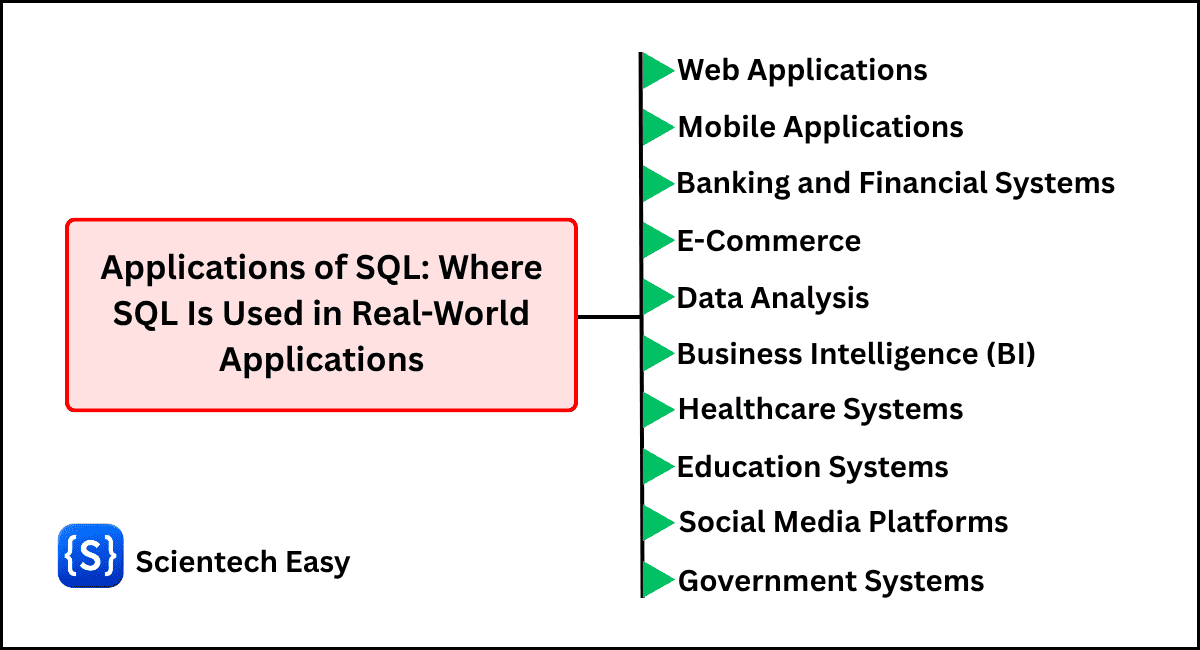
1. SQL in Web Applications
SQL powers the backend of database-driven web applications by storing, organizing, and serving structured data on demand. For example, an online learning website uses a relational database to track interconnected entities:
- User accounts & credentials
- Courses, modules, and lessons
- Student enrollments and progress tracking
- Quiz submissions and grading records
- Discussion forum comments and reviews
How a Web Application Queries the Database
When a user logs into their account or visits their profile page, the backend application sends a structured SQL query to the database to fetch their specific details:
-- Fetch user profile data based on a verified account identifier
SELECT username, email, created_at
FROM users
WHERE user_id = 101;
The database engine executes the query and returns the matching record to the backend server. The backend formats this data (typically as JSON) and sends it to the frontend to render the user’s dashboard.
Best Practice Note: In production web applications, backend developers use parameterized queries (prepared statements) or Object-Relational Mappers (ORMs) to execute SQL securely and prevent SQL Injection (SQLi) vulnerabilities.
Common SQL Use Cases in Web Development
Web developers use SQL across the entire application lifecycle:
- User Authentication & Profiles: Managing user registrations, password hashes, profile settings, and role-based permissions.
- Dynamic Content Delivery: Serving dynamic blog posts, course modules, video metadata, and documentation.
- E-Commerce & Carts: Managing live product catalogs, temporary cart states, and finalized orders.
- Search & Dynamic Filtering: Querying products or articles by category, tag, price range, and date.
- Activity Feeds & Logs: Storing system audit trails, user comments, notifications, and interaction histories.
2. SQL in Mobile Applications
Mobile applications (on Android and iOS) rely on SQL to store and manage structured data. In mobile development, SQL is used in two fundamental ways: on the remote server (cloud) and locally on the user’s device.
Remote Cloud Storage (Via Backend APIs)
When a mobile app needs to access user accounts, process orders, or fetch live feeds, it communicates with a central cloud database.
For security and performance reasons, a mobile app never connects directly to a remote SQL database. Instead, it talks to an intermediate backend service (such as a REST API or GraphQL API).
Why this API layer is critical:
- Security: Prevents exposing sensitive database credentials inside mobile app packages.
- Access Control: Verifies user identity and permissions before reading or writing data.
- Traffic Management: Protects database servers from crashing under millions of concurrent mobile connections.
Local On-Device Storage (Embedded SQLite)
Mobile apps also use SQL directly on your phone using embedded lightweight databases like SQLite. Android (via the Room library) and iOS (via Core Data or native SQLite) store data right on the physical device.
Local SQL is essential for:
- Offline-First Functionality: Allowing users to read notes, write drafts, or view downloaded media without an active internet connection.
- Instant Performance & Caching: Loading app screens instantly from local memory before fetching new updates from the server.
- Background Syncing: Saving user actions locally and automatically syncing them to the cloud database once the network reconnects.
3. SQL in Banking and Financial Systems
Banking and financial applications handle highly structured data and require strong consistency, security, auditing, and transaction processing. SQL and relational databases can be used to manage information such as:
- Customer accounts
- Account balances
- Transactions
- Loans
- Payments
- Transfers
- Transaction history
- Financial reports
For example, a banking system often needs to retrieve recent transactions for a customer. A simplified query could look like:
SELECT transaction_id, amount, transaction_date
FROM transactions
WHERE account_id = 1001
ORDER BY transaction_date DESC;
The database can return the customer’s transactions in reverse chronological order.
Why SQL Is Useful in Banking
Relational databases provide features such as:
- Transactions
- Constraints
- Referential integrity
- Access control
- Structured data relationships
These features are useful for applications where maintaining correct and consistent data is critical.
4. SQL in E-Commerce
E-commerce platforms are one of the clearest real-world examples of SQL applications. An online shopping system needs to store, retrieve, update, and organize large amounts of structured information about products, customers, orders, payments, and inventory.
An e-commerce database may contain tables such as:
- customers: Stores customer information, such as user accounts, encrypted credentials, and delivery addresses.
- products: Stores product titles, descriptions, SKUs, and base prices.
- categories: Organizes catalog hierarchy (e.g., Electronics, Fashion, Home).
- inventory: Tracks real-time available stocks across different warehouses.
- orders: Records order details such as order date, total amount, shipping status.
- payments: Stores payment-related records, such as transaction IDs, and payment gateways.
- reviews: Stores verified buyer ratings and customer feedback.
For example, when a customer searches for products below ₹5,000, the application can send an SQL query to the database:
SELECT product_name, price
FROM products
WHERE price < 5000
ORDER BY price ASC;
This query retrieves products costing less than ₹5,000 and sorts them from the lowest price to the highest.
Query Result:
| product_name | price |
|---|---|
| Mouse | ₹800 |
| Keyboard | ₹2,000 |
| Headphones | ₹3,500 |
The e-commerce application can then display these products on the customer’s screen.
SQL Applications in E-Commerce
SQL can therefore support many important e-commerce operations:
- Searching for products.
- Filtering products by price or category.
- Retrieving product details.
- Managing customer accounts.
- Creating orders.
- Retrieving order history.
- Managing inventory.
- Recording payment-related data
- Storing product reviews
- and many more.
5. SQL in Data Analysis
SQL is the industry-standard tool for data analysts and data scientists. It allows analysts to extract, filter, aggregate, and transform raw database records into actionable business insights. Data analysts can use SQL to:
- Filter records.
- Group data.
- Calculate totals and averages.
- Compare values.
- Generate reports.
- Combine information from multiple tables.
For example, the below query calculates the average salary for each department.
SELECT department, AVG(salary) AS average_salary
FROM employees
GROUP BY department;
Query Result:
| department | average_salary |
|---|---|
| IT | ₹75,000 |
| Sales | ₹52,000 |
| HR | ₹60,000 |
6. SQL in Business Intelligence (BI) and Reporting
Companies rely on reports and dashboards to see how their business is performing and to make smart decisions. SQL pulls raw data out of databases and summarizes it into clear business metrics. Using SQL, companies can automatically calculate:
- Total monthly sales and revenue by region.
- Top-selling products.
- Number of new customers.
- Customer retention
- Average order value
To generate a monthly revenue chart, a business analyst can run an aggregation query:
-- Calculate total revenue for each month
SELECT
    EXTRACT(YEAR FROM order_date) AS sales_year,
    EXTRACT(MONTH FROM order_date) AS sales_month,
    SUM(total_amount) AS total_sales
FROM orders
GROUP BY
    EXTRACT(YEAR FROM order_date),
    EXTRACT(MONTH FROM order_date)
ORDER BY
    sales_year DESC,
    sales_month DESC;
Query Result:
| sales_year | sales_month | total_sales |
| 2026 | 7 | ₹4,50,000 |
| 2026 | 6 | ₹3,80,000 |
| 2026 | 5 | ₹4,10,000 |
7. SQL in Healthcare Systems
Healthcare applications need to manage many types of structured information. These applications use SQL to manage:
- Patient and doctor information.
- Appointments.
- Hospital departments.
- Billing records.
- Medication information.
- Test results.
- Admission and discharge records.
8. SQL in Education Systems and University Portals
Schools, colleges, universities, and online learning platforms rely on Student Information Systems (SIS) and Learning Management Systems (LMS) to manage thousands of students, faculty members, and academic courses.
SQL helps educational institutions connect multiple relational tables to track everything from attendance to final grade sheets. For example, the following query retrieves students who scored at least 80 marks and sorts them by their marks.
SELECT student_name, marks
FROM exam_results
WHERE marks >= 80
ORDER BY marks DESC;
Query Result:
| student_name | marks |
| Ananya Sharma | 95 |
| Rahul Mehta | 88 |
| Priya Nair | 82 |
| Rohan Verma | 80 |
9. SQL in Social Media Platforms and Online Communities
Social media platforms like Instagram, LinkedIn, Facebook, and X handle massive amounts of structured, interconnected data. Relational databases powered by SQL manage the following:
- User profiles
- Posts
- Comments
- Likes and follows
- Groups
- Notifications
For example, when a user opens their followers list, the backend executes an indexed SQL query joining user profiles with follower connection tables:
-- Retrieve the list of users following user ID 501
SELECT
    u.user_id,
    u.username,
    u.full_name,
    f.followed_at
FROM follows f
JOIN users u ON f.follower_id = u.user_id
WHERE f.following_id = 501
ORDER BY f.followed_at DESC;
Query Result:
| user_id | username | full_name | followed_at |
| 1042 | @tech_coder | Rahul Verma | 2026-08-15 14:20:00 |
| 2088 | @dev_sneha | Sneha Roy | 2026-08-14 09:10:00 |
| 3150 | @amit_sql | Amit Kumar | 2026-08-12 18:45:00 |
10. SQL in Government Systems and Public Sector Portals
Government agencies and public sector departments manage vast amounts of structured civic data. From issuing citizen identification cards to collecting taxes, SQL-powered relational databases provide the reliability, security, and traceability required for public administration.
A government database system organizes critical civic records into structured schemas:
- Citizen Identity & Registrations
- Taxation & Revenue
- Licensing & Permits
- Public Welfare & Benefits
- Civil Services & Payroll
- Land & Property Records
For example, when a citizen enters their reference number on a public service portal to track a passport, driver’s license, or welfare application, the backend executes an indexed query:
-- Retrieve the latest application status for a citizen
SELECT
    application_id,
    applicant_name,
    service_type,
    submission_date,
    status
FROM applications
WHERE application_id = 5001;
Query Result:
| application_id | applicant_name | service_type | submission_date | status |
| 5001 | Rajesh Sharma | Driver’s License Renewal | 2026-08-01 | Approved – Dispatched |
How SQL Works Across Different Programming Languages
SQL is not tied to any single programming language or operating system. It is a standardized language used to communicate with and manage data in relational database management systems (RDBMSs).
Modern programming languages such as Java, Python, JavaScript (Node.js), PHP, C#, Go, and Ruby can connect to relational databases such as PostgreSQL, MySQL, SQL Server, and Oracle.
Programming languages communicate with relational databases through database drivers, libraries, frameworks, or APIs. For example, a Python application can send SQL queries to a PostgreSQL database, while a Java application can communicate with a MySQL or Oracle database.
In an application, the programming language handles the application’s logic and functionality, while SQL is used to retrieve, insert, update, and delete data in the relational database.
Although SQL is standardized, different database systems may provide their own SQL dialects, extensions, functions, and features. Therefore, SQL syntax can vary slightly between database systems.